Fraud is a growing problem worldwide, and it shows no sign of abating.
Thanks to technology, rampant competition for profit, a vulnerable older population, the wealth gap, and plain-old greed, fraud will likely become America’s most common crime.
Fraud is easier than ever. Plus, you don’t have to leave your house. As old criminals used to say, “You can make more money stealing with a pen than a gun,” fraud can now be done online using existing software and AI, making it easier to scam people in your own city or around the world.
Plus, crypto and offshore bank accounts make it easier than ever to transfer and hide money.
Rampant fraud has also spurred global anti-fraud efforts by international groups such as NICE Actimize and the Association of Certified Fraud Examiners (ACFE). Reports from these groups show that major corporations worldwide will have to spend billions on anti-fraud technology, including more advanced AI analysis, to protect their customers. These costs will invariably be passed along to customers.
Cybercrimes, including internet fraud, are not new. The FBI established its Internet Crime Complaint Center (IC3) in 2020, long before AI.
Every state in the union is a target for all types of fraud, with California, Texas, and Florida consistently ranking highest for total IC3 cybercrime and fraud complaints. Florida leads the nation in fraud and identity theft reports per capita and overall vulnerability.
The statistics buttress this situation. According to the FBI’s 2025 Internet Crime Report, cyber-enabled crimes defrauded Americans of nearly $21 billion, with cryptocurrency and artificial intelligence-related complaints among the costliest.
The Internet Crime Complaint Center (IC3) received 1,008,597 total complaints, up from 859,532 in 2024, or about 3,000 per day.
The FBI said that the most frequently reported complaints were phishing/spoofing, extortion, and investment schemes. Americans over 60 reported approximately $8 billion in losses, up 37% from 2024.
The IC3 received approximately 453,000 cyber-enabled fraud complaints, with reported losses exceeding $18 billion. Investment fraud remains the primary driver, accounting for nearly 49% of all scam-related losses.
Americans who submitted complaints involving cryptocurrency reported the highest losses, with 181,565 complaints totaling more than $11 billion. As other crypto critics have noted, crypto’s main purposes are money laundering, tax evasion, fraud, and undermining the Federal Reserve.
This chart lists the fraud categories the FBI tracks. It’s a long list and ranges from sextortion and account takeover to government impersonation and investment club scams. Related threats include cyberattacks that hijack networks, cryptocurrency heists, and corporate espionage.
Financial fraud remains one of the most prevalent. The FBI’s Recovery Asset Team (RAT) reported 3,900 financial fraud incidents totaling about $1.16 billion in 2025. This included attempted thefts of $679 million. The FBI’s RAT team froze about 58% of these attempted thefts.
Fraud Targets the Elderly
Fraudsters most often target older and very young Americans. The key difference is that the median amount lost for those 19 and younger was $189, compared with $1,650 for those 80 and older. 
Consumers reported losing $12.5 billion to scams in 2024 (the latest full year of data available). However, because victims may be ashamed or not realize they were defrauded, law enforcement agencies believe only 2%- 6.7% of victims report their losses. After accounting for underreporting, the Federal Trade Commission (FTC) estimated that in just one year, Americans lost $196 billion to scammers.
The Scams in Florida
The best example of rampant fraud in all categories is what’s happening in Florida.
After almost 30 years of Republican rule in the state legislature, Florida has consistently slid to the bottom of many livability and financial security rankings. Its rising cost of living, congestion, and poor school system, along with the lowest teacher pay in the U.S., point to this slide.
Florida is also a lenient state when it comes to prosecutions. Although law enforcement and the judicial system will differ, Florida is a welcome home to white-collar criminals. (White-collar crimes generally involve nonviolent, financially motivated actions like fraud, embezzlement, identity theft, money laundering, and forgery.)
According to attorney Kevin J. Kulik of Fort Lauderdale, “The Sunshine State is home to three of the top 25 cities with the most white-collar crime arrests: Miami, Orlando, and Tampa ranked #2, #7, and #10, respectively. To put it in perspective, only California had more cities on the list, with five, even though it is almost double in population.” Kulik was citing a report in the South Florida Reporter.
Another law firm, Trombly and Hanes of Tampa, said on their website that “According to recent data from the U.S. Department of Justice, the Middle District of Florida (covering the Tampa Bay area) led all U.S. Federal Districts in the number of white-collar crimes charged in April 2022. Fraud was the most commonly charged white-collar crime. Historically speaking, Florida has long been considered a hotbed for white-collar crime based on the opportunities present in the 1970s and 1980s and the maze of agencies responsible for tracking down white-collar crime schemes.
This dismal designation is just one of many. The Federal Trade Commission reports that people across the United States lost nearly $16 billion to fraud schemes last year, with Florida ranking near the top in reported cases and total losses. The report, The Consumer Sentinel Network Data Book of 2024, found that Florida led the nation with approximately 2,163 reports per 100,000 residents.
More red flags were raised by the George law firm of Miami, Fort Lauderdale, and West Palm Beach, which said, “South Florida has earned an infamous reputation as a hotbed of fraud. In fact, the Miami metropolitan area is often called the “fraud capital” of the United States. Year after year, federal data show Miami, Fort Lauderdale, and West Palm Beach leading the nation in reports of scams, identity theft, and financial crimes. In 2024 alone, South Florida ranked #1 in the country for fraud, with roughly 2,800 fraud reports per 100,000 residents, the highest per capita rate nationwide. Floridians reported losing an astounding $866 million to fraud that year.”
The George law firm offered some reasons why fraud is so rampant. Among them are Miami’s reputation as the “target-rich environment” of the elderly, retirees, young people who are risk takers, the area’s tradition of hosting organized Medicare fraud rings and drug outlets, and “an existing ecosystem of fraud – complete with mentors, black-market services (like patient recruiters or document forgers), and money-laundering channels.”
Hurricane Insurance Fraud
Florida also has a less common type of fraud not seen in many other states: hurricane-related insurance fraud. More specifically, insurance companies do not pay the full amount of damage homeowners suffer after a hurricane. According to a 60 Minutes Report, homeowners will not recover the full cost of damage. Home insurance companies can significantly reduce damage claims by altering reports and refusing to cover storm damage to roofs and other expensive parts of a home.
A report by the Merlin Law Group found that “Ron DeSantis and the ‘Friends of Ron DeSantis’ political committee have taken a combined $3.9 million in contributions for insurance industry players—not counting the tidy $125,000 that went to Ron’s 2022 inaugural committee. “Including their donations to the Republican Party of Florida since January 1st, 2019 (days before DeSantis took his oath of office), campaign money from the insurance industry balloons to more than $9.9 million.”
Florida Welcomes White-Collar Criminals
Florida welcomes white-collar criminals. From Donald Trump to shady real estate developers and payday loan scammers, Florida is a haven for white-collar criminals. According to white-collar crime statistics, the most common crime is insurance and financial fraud. As of 2022, Florida had the most convicted money-laundering criminals. Based on 2019 statistics, Miami ranked second in the U.S. with 4,237.27 white-collar crimes per 10,000 people. (Richmond, Va. was first.)
White-collar crimes are highly profitable, and the chances of getting away with them unscathed are increasing. White-collar crime prosecutions decreased by 53.5% from 2011 to 2021. As of 2021, annual losses from white-collar crime range from $426 billion to $1.7 trillion. Zippia says the wide range of failures reflects a lack of prosecutions. 
At the individual consumer level, fraud victims often feel embarrassed, disbelieved, and ashamed. Those are the main reasons why only an estimated 15% of the nation’s fraud victims report their situation to law enforcement, according to the Miami Police Department. Even when fraud is reported, victims of credit card fraud have a one in 1,000 chance of having the crime solved by police.
Fraud gets a Big Boost From Trump
Fraud is President Donald Trump’s signature crime. He has now made it a pattern for other criminals to follow at the state and national levels by removing inspectors general at federal agencies, pardoning fraudsters, and dismantling consumer protection agencies, promoting cryptocurrencies that are being used as a leading medium of tax evasion and fraud, and pushing a libertarian policy at the state and federal levels that will remove fraud enforcement capabilities to protect average citizens.
Trump has also gone to extra lengths to pardon convicted fraudsters during his two terms in office. Here is a complete list at this link.
Florida also honors its biggest fraudsters. Florida MAGA Republican Senator and former Florida
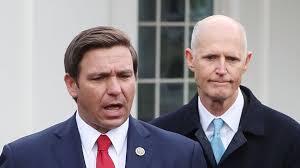
Governor Rick Scott was also the indirect beneficiary of the largest Medicare-Medicaid fraud scheme in U.S. history, a fraud scheme that was settled for $1.7 billion. While the fraud scheme was developing, Scott served as CEO and Chairman of Columbia/Hospital Corporation of America. He escaped prosecution and even received a bonus from the company. He later became governor and senator from Florida. Scott shows that in Florida, crime pays.
The Most Common Frauds in Florida
The most commonly reported fraud types in Florida include phony debt collections, identity theft, COVID-related federal fund distributions, impostor scams, credit bureau, banking and lending, mobile phone, and auto-related fraud (fake accidents and inflated repair costs).
The Miami-Ft. Lauderdale-Pompano Beach area, for instance, is the nation’s top location for mortgage fraud, according to a Q3 2022 CoreLogic study. This distinction occurred even though the population of Miami is about six million, compared to the New York metropolitan area, which has a population of 19 million and ranks fourth in the same fraud data report
Florida Ranks #1 in Internet Fraud
Florida also has the highest number of internet fraud cases, according to a Federal Trade Commission (FTC) report.
According to the latest FTC Data Book, about three million consumer complaints were filed with the FTC in 2018, and Florida ranked No. 1 for fraud and No. 4 for identity theft. The top fraud scams affecting Floridians were debt collection, identity theft, and impostor hoaxes.
Real estate sales, development, and construction are also ripe for fraud. A December 2021 WFTV report, “Central Florida becoming the Wild West of real estate scams,” found that people were selling land they did not own through online real estate sites. Rental frauds are also common. Another area ripe for investigation is Community Redevelopment programs that involve HUD money and public-private real estate developments that misuse federal and state monies.
In April 2021, Boca Raton’s former mayor, Susan Haynie, pleaded guilty to failing to disclose financial ties to a local real estate tycoon while in office. Florida investigators said Haynie didn’t report more than $330,000 in earnings from developers and commercial property owners.
For average consumers, fraud is also conducted by handymen, real estate agents, and home inspectors. A retired plumber from New York bought a condo in Palm Beach County from an elderly owner but soon noticed the air conditioning was not working. He checked the wiring and bought a new thermostat, but it did not fix the problem. He then checked the attic and found the air-conditioning ducts were never connected to the unit. The man said the elderly owner could never inspect the attic, so the repair people collected the money and disappeared.
The Global Art of Deception
Fraud is the crime of deception. But given the level of public corruption, it’s not surprising that too many people are tempted to get something for nothing from an unsuspecting victim.
Can law enforcement police every fraud? Given the millions corporations, public utilities, the federal government, government agencies, schools, and hospitals spend on anti-fraud programs, taxpayers will have to assume these new costs.
In the end, ordinary people will foot the bill to prevent the same frauds targeting them directly and indirectly. AI will only increase the dangers, and fraud prevention will be an incessant part of modern life.