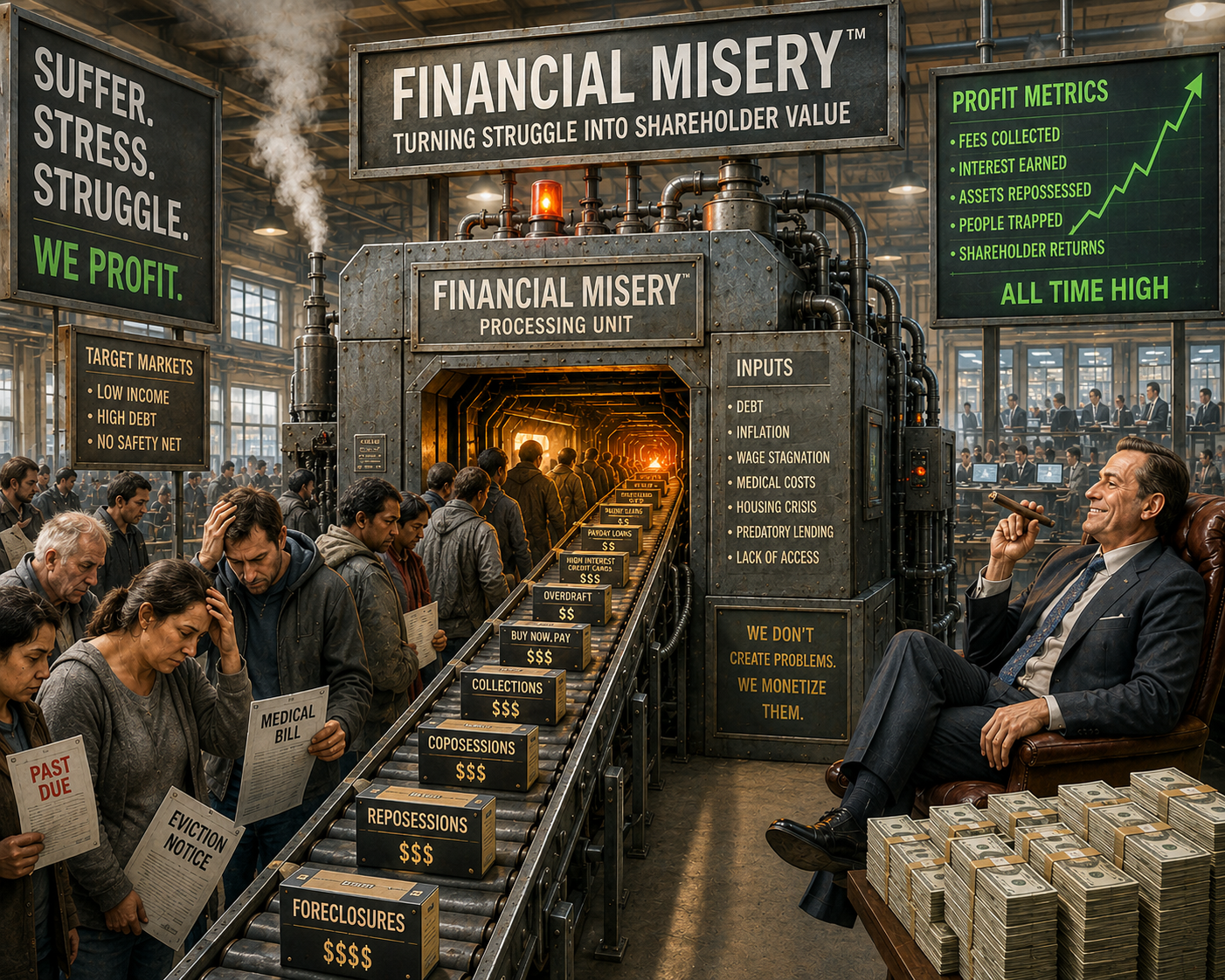
Need money for rent? How about student loans? Or pay a car loan, or an electric toothbrush?
No problem.
Just become a slave to the credit-industry Gestapo and get a loan, extended payment plan, or trade in an insurance policy or car, or take out a second mortgage.
Capitalism is very creative, and unregulated capitalism in the stage of monopoly capitalism is even more unethical and aggressive in monetizing anything with real value.
The loan and credit industries prey on the desperate who need to buy essentials, and even luxuries to satisfy some desire.
These people, average Americans struggling to replace a broken refrigerator, repair an air conditioner, or pay for groceries, are easy prey for lenders of all stripes in the most advanced consumer and advertising-driven society in history.
Every year, consumers are burdened by an estimated $18.77 trillion in consumer debt, with net new borrowing increasing total debt by roughly $200 billion to $400 billion annually. This is broken down to $105,444 in total debt per household, according to the Federal Reserve Bank of New York and Experian.
Of this per-household total debt, 70% is from mortgages, with the average mortgage of $272,628; 9% from car and student loans; 7% from credit cards; and 5% from miscellaneous loans.
A study by Schroders found that one-third of Americans older than 35 have more in credit card debt than they have in savings. This includes 22% of people over age 70 who reported this same problem, while 28% of people age 60 to 69 owed more to credit card companies than they had in savings.
American consumers are in a constant state of indebtedness. Consumers are constantly cycling through debt. Non-mortgage consumer credit grows at a seasonally adjusted annual rate of roughly 2.6% to 3.3%. “This means that even after Americans collectively pay off hundreds of billions of dollars in auto loans and credit card bills every year, they still net-borrow tens of billions more than they did the year before,” according to the Federal Reserve’s G.19 Consumer Credit Release.
This means consumers are on the debt-repayment treadmill and many will never get off. They will be working for the credit industry Gestapo for their entire lives.
This is because the individual credit rating agencies—Equifax, Experian, and TransUnion—control a person’s financial destiny. These agencies- Equifax, Experian, and TransUnion—generally have net profit margins ranging from 10% to 18%, while major credit card companies (like Visa, Discover, and Mastercard) see net margins exceeding 50%. Subprime lending companies that target the poor are largely unregulated, and charge high upfront fees and interest rates.
A low credit score (in the 500s and below) means an individual will pay higher interest rates on anything they purchase on credit, from cars to mortgages, and may not even pass an employer’s requirements to get a job.
An academic report in Science Direct found that “There is a significantly negative relationship between household debt and wealth accumulation for poor households but a significantly positive relationship for wealthy households. Wealthy households can benefit more from investment debt, but poor households cannot. In short, poor people borrow to pay basic expenses, while wealthier people borrow to pursue positive investment returns.
So what do the defenders of the system recommend? HELOC loans, debt consolidation, personal loans, second mortgages, selling your life insurance policy, buying on credit, and starting a garden. These old, anti-consumer suggestions add to cutting consumption, foregoing vacations and entertainment, eating more at home, and frugality on steroids. None of these are solutions to this perpetual, structural situation.
Being poor in a society driven by consumption and expanding debt widens the wealth gap. Poor people face greater credit risk, so they pay higher interest rates. This depletes their ability to invest (what economists call “wealth extraction”), producing the rat-wheel analogy of a “negative feedback loop” when poor people cannot escape their indebtedness. This sad state can continue for generations.
So, when Trump downplays the “affordability crisis,” Republicans should consider the trend line in borrowing and compare it to the wealth inequality gap. How wide can the wealth gap expand before it explodes? This picture captures the dire circumstances of the average American consumer.
The Contradictions of Capitalism
The current perpetual indebtedness of average consumers is no accident. It is part of the system. It is much more than becoming a victim of incessant advertising and being enticed by new online borrowing opportunities.
Being an American wage slave is an essential part of the current economic model. In the seminal book, Monopoly Capital, by the Marxist economists Paul Baran and Paul Sweezy, U.S. evolutionary economic history of capitalism was laid out in terms described by Polish economist Paul Kalecki.
According to Kalecki, “Workers, the vast majority of the population in the rich countries, had little or no access to economic surplus in the forms of profit, interest, and rent. Workers’ income was almost exclusively wage income. Most working people lived from paycheck to paycheck (though sometimes made large purchases on credit) and had no savings to speak of. Workers therefore spent what they got on necessities, or what economists sometimes called wage goods.”
This indebtedness stems from the fact that only a small segment of average citizens has a direct investment in the stock market. According to Yahoo Finance, “Roughly 58% of U.S. adults (about 156 million people) own stock, mostly through retirement accounts like 401(k)s or IRAs. However, ownership is heavily concentrated: the wealthiest 1% own more equity than the bottom 90% combined, and participation drops sharply among lower-income and minority households.”
So, when Trump equates major advances in the stock market with creating new wealth for all Americans, he is grossly uninformed. Those market gains go to his top contributors, not average Americans.
The Happy Lenders Who Control the Game
Among the lenders, average citizens become prey for unethical predators who need to appease stockholders’ demands for more revenue or salesmen pushed to meet quotas.
Go to Facebook, order an electric toothbrush, and you can pay for it via an installment loan.
A homeowner in Tacoma, Washington, wanted a new $5,000 carpet, and Empire Carpet referred her to a loan company that would charge her 25% interest. Since most traditional personal loans, auto loans, and peer-to-peer loans use an amortized structure with monthly payments, her total payments to the lender would have been $7,156 (principal and interest). The consumer skipped the carpet and decided to paint the floors instead.
Almost any real or financial asset an average consumer has can be converted into a loan, or “monetized,” by the creative forces of modern financial capitalism. This is also known as collateralized financing.
If you have an insurance policy, borrow against it (Cash-Value Life Insurance Loans). If you own stocks, get a Margin Loan or Securities-Based Lines of Credit (SBLOC). If you have equity in a house or condo, get a second mortgage: get a cash payout and roll that amount into a second mortgage. Second mortgages just delay the pain of paying back the loan over time.
Then there are the buy-now-pay-later online services offered by Affirm, Flex, and Zip. The expanded use of AI will create customized lending enticements (aka Hyper-Personalized Credit) that will offer lending terms based on a borrower’s real or imagined uniqueness. This is related to fintech loans, digital loans issued by non-bank financial companies.
For their part, banks and private lending firms have long-established selling points to get consumers to take on more risk in order to pay their bills. The most common argument is the good old tax-efficiency argument.
One major global bank tells potential borrowers that “while selling investments that have gained value might trigger capital gains taxes, borrowing, such as with an SBLOC, lets you leverage the value of those assets without selling them. In some cases, loan interest payments may be deductible against your taxable income when loans are used for investment purposes. Consider consulting a tax professional to learn how borrowing against your assets could affect your tax liability.”
The other main argument is to stay invested in the market while you borrow against the portfolio.
It’s no coincidence that these tax breaks were written into law by the banks and lenders in order to fuel the lending business.
Perpetual Borrowing and Indebtedness Is Part of Capitalism
Getting additional cash is a human need. The first pawn shops began in ancient China, Greece, and Rome, when a property owner could sell an item to the pawnbroker or take the loan and repay it within a certain period. If they missed the deadline, the pawnbroker kept the collateral, plus any principal and interest the borrower owed.
This lending model is ancient.
Today, with the rise of financialization, online credit verification systems provide expanded access to more types of real and financial assets. This includes margin payments on stock purchases,
Asset-backed securities allow investors to buy a stake in the future payouts from a pool of debts or assets. Auto loans and credit card balances are routinely turned into securities. Others are spun from less traditional collateral: songwriting royalties, data centers, fast-food franchises — and now, cash advances given to personal injury plaintiffs.
Indentured Servitude is Back
Indentured servitude was outlawed in the 1600s, but thanks to the exorbitant costs of obtaining a college degree, assigning your future earnings to a creditor has returned as the latest, and most unethical form of financial exploitation in the monopoly capitalism society.
Indentured servants first appeared in colonial America in 1607 as a pool of cheap labor. At the time, plantation owners needed cheap labor, so indentured servants (mainly poor white people from Ireland or England) were given trans-Atlantic passage in exchange for working off the cost of transportation and food over several years.
Working your way out of a debt owed to an employer was the topic of Charles Dickens’ 18th-century England. His story included debtor’s prison, jail sentences, forced labor, and indentured servants. But as this Bloomberg News article shows, students who cannot afford to pay for college are now entering the latest form of financial engineering: an income-sharing agreement (ISA) with investors.
In exchange for this ISA, the student profiled in the article agreed to pay a percentage of her salary to her investors per month for 8 ½ years.
According to the article, “today, about a year after graduation, Wroblewski [the former student] makes $50,000 a year as a higher education recruiter in Winchester, Va. So, the cut [to her investors] comes to $279 a month, less than her car payment.”
While “greed is good” has long become an abhorrent cliché, the use of ISAs raises greed to a new level. Not only is it the peak of predatory lending, but it also demonstrates that tuition costs are preventing many from attending college. ISAs, combined with stories about college students living in their cars because they cannot afford dorm rooms, accompanied by college teaching assistants and teachers who cannot afford to live near the schools where they teach, should be an embarrassment to any modern society.
But using ISAs is really a form of student pimping. While it is all voluntary, it is also predatory, with all the power on one side of the equation.
The student who was profiled in the Bloomberg article attended Purdue University, which said it has worked with investors, such as hedge funds and private investors, to create ISAs.
The article also quotes a hedge fund manager who said: “I envision a whole new equity market for higher education in the next five years where today there’s only debt,” says Chuck Trafton, who runs hedge fund FlowPoint Capital Partners LP, which has invested in ISAs, including Purdue’s. ISA experts say they have fielded calls from some of the world’s largest investment managers that are considering investing in the contracts. And Tony James, executive vice chairman of money manager Blackstone Group LP, formed the Education Finance Institute to help schools study and develop ISAs.”
The article did not quote any ethicists on this new financial product, nor did it ask any of the investors about the prospects of making colleges tuition-free.
There is also a school of thought that tries to explain the rise in perpetual indebtedness to the application of an imperialist expansion to domestic Americans. Traditionally, imperialism has targeted non-U.S. nations. But as colonialism and imperialist opportunities have become harder to find, predatory capitalist creations, such as private equity, hedge funds, and high-tech financial companies, have begun to target their fellow citizens as easy prey for lending gimmicks and more innovative ways of profiting from misery, including personal injury lawsuits.
Another theory is that a population in chronic indebtedness is too busy being afraid and nervous to realize and act against the source of their misery. In earlier times, royalty knew that a hungry and near-destitute population could not strike or protest. Today, the “invisible poor,” or an indebted population, may appear prosperous but must never stop working or suffer a financial setback to maintain their lifestyle. Meanwhile, corporations employ actuaries who make it almost impossible for average consumers to find cheaper plans for utilities, Internet, phone service, medical services, and mortgages. This locks consumers into their own world of everyday indebtedness.
Consumer indebtedness is a permanent situation under the current American system. It’s predatory, stressful, and is not conducive to building a functioning democracy.