While the national news media celebrates the big, national Democratic sweep of Congress, many governors’ races, and statehouse wins, Florida remains the exception.
It is still a MAGA Republican state, and the national mood of disgust over Trump’s criminality and war policies doesn’t seem to concern many Floridians.
Florida is suffering from king tides flooding both coasts, rising costs of living, and other concerns voters across the nation have raised.
But in Florida, those concerns are downplayed as its residents continue to vote for MAGA Republicans. But it was close. The governor’s race between a DeSantis-picked candidate and the Democrat David Jolly was decided by roughly 100,000 votes out of 8.2 million cast.
The Senate race between progressive Angie Nixon and Republican incumbent Senator Ashley Moody was very close (Moody had 50.8% of the vote vs. Nixon with 48.1%). Nixon, a democratic socialist, was ignored by the DNC and received almost no support from Chuck Schumer, who opposes the party’s democratic socialist wing. Florida Democrats said more DNC support could have produced an upset.
What’s the problem?
There are a few reasons: retirees here fear being depleted of money. Rising costs, high homeowners’ insurance, the threat of hurricanes, and talk of cuts to Social Security, Medicare, and Medicaid are real threats, but retirees don’t seem to see a solution.
This fear of financial strain helps explain why a local Amendment 3, a move by MAGA Governor Ron DeSantis to drastically reduce local property taxes, won its referendum. DeSantis envisions state governments at all levels operating with minimal property taxes. This is short-term budgeting, but it appeals to retirees and financially stressed taxpayers who welcome any savings, even if it makes their communities less livable.
As expected, the amendment was bitterly opposed by police, firefighters, and municipal workers who face layoffs as municipal finances and services are cut over the next few years.
Many retirees in Florida are old Republicans. They are old chronologically and old politically. Depending on the community, retirees can be in their mid-70s and up. Many are happy to play canasta, golf, and mahjong all day and sit by the pool.
One poll worker assigned to a large middle- to lower-middle-class retirement community in Boynton Beach, Palm Beach County, observed that many voters have been Republicans their entire lives. This makes them conservative at all levels: socially, culturally, in their everyday activities, and in how they vote. Many who live in this community come from New York City and its boroughs, exalt the military, read the New York Post, attend church, and watch FOX News. This is the traditional Republican base. They vote Republican out of habit. Current news events about Trump’s criminality and corruption do not concern them.
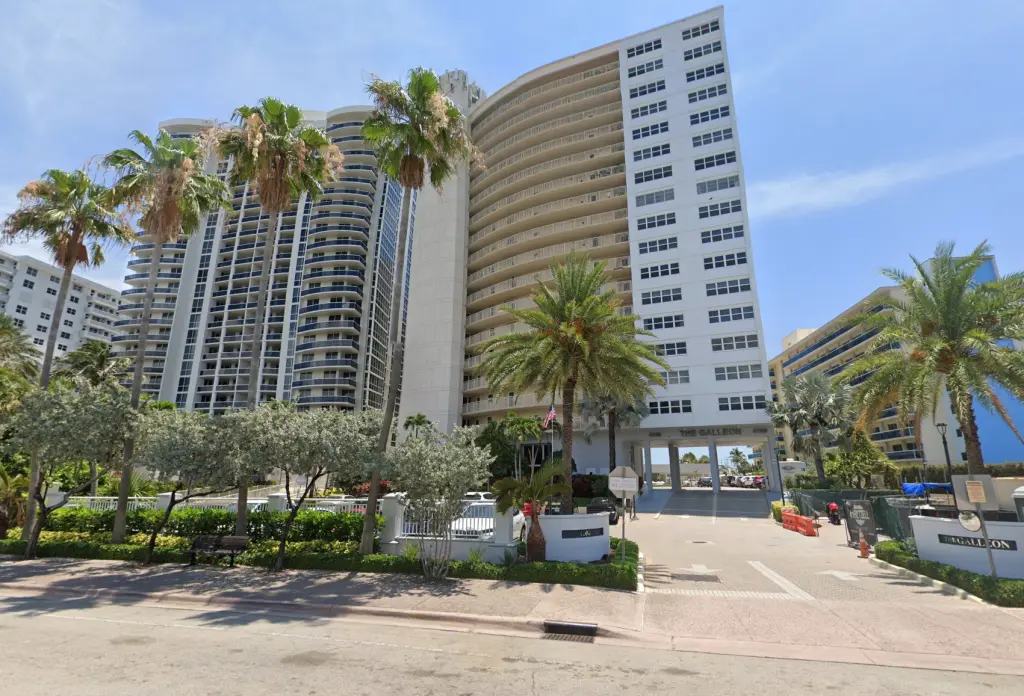
These retirees face serious financial pressures and cannot tolerate any increase in their HOA (homeowners association) dues or special assessments for community maintenance and development. For instance, the oceanfront Galleon condominium in the Galt Ocean Mile of Ft. Lauderdale recently assessed its residents a one-time charge of between $135,000 and $320,000 per unit to fund $36 million in oceanfront concrete repairs. This charge is in addition to HOA fees that still must be paid. The huge assessment has resulted in “a potentially life-altering financial burden for some owners,” according to a report in the New York Post.
While that’s an extreme example, Florida has other home-related expenses outside homeowners’ control: home and auto insurance and fraud of all types.
Fraud in Florida is Big Business
After almost 30 years of Republican rule in the state legislature, Florida has consistently slid to the bottom of many livability and financial security rankings. Its rising cost of living, congestion, and poor school system, along with the lowest teacher pay in the U.S., point to this slide.
Florida is also a lenient state when it comes to prosecutions. Although law enforcement and the judicial system will differ, Florida is a welcome home to white-collar criminals. (White-collar crimes generally involve nonviolent, financially motivated actions like fraud, embezzlement, identity theft, money laundering, and forgery.) 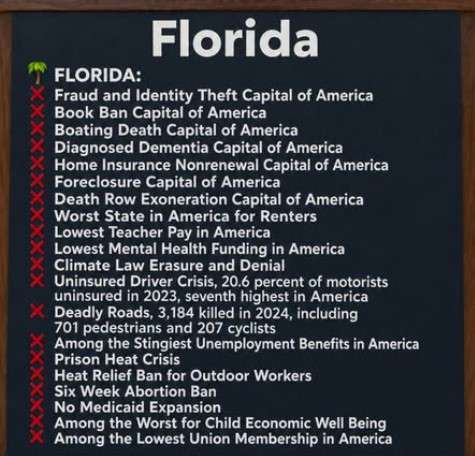
According to attorney Kevin J. Kulik of Fort Lauderdale, “The Sunshine State is home to three of the top 25 cities with the most white-collar crime arrests: Miami, Orlando, and Tampa ranked #2, #7, and #10, respectively. To put it in perspective, only California had more cities on the list, with five, even though it is almost double in population.” Kulik was citing a report in the South Florida Reporter.
Another law firm, Trombly and Hanes of Tampa, said on their website that “According to recent data from the U.S. Department of Justice, the Middle District of Florida (covering the Tampa Bay area) led all U.S. Federal Districts in the number of white-collar crimes charged in April 2022. Fraud was the most commonly charged white-collar crime. Historically speaking, Florida has long been considered a hotbed for white-collar crime based on the opportunities present in the 1970s and 1980s and the maze of agencies responsible for tracking down white-collar crime schemes.
This dismal designation is just one of many. The Federal Trade Commission reports that people across the United States lost nearly $16 billion to fraud schemes last year, with Florida ranking near the top in reported cases and total losses. The report, The Consumer Sentinel Network Data Book of 2024, found that Florida led the nation with approximately 2,163 reports per 100,000 residents.
More red flags were raised by the George law firm of Miami, Fort Lauderdale, and West Palm Beach, which said, “South Florida has earned an infamous reputation as a hotbed of fraud. In fact, the Miami metropolitan area is often called the “fraud capital” of the United States. Year after year, federal data show Miami, Fort Lauderdale, and West Palm Beach leading the nation in reports of scams, identity theft, and financial crimes. In 2024 alone, South Florida ranked #1 in the country for fraud, with roughly 2,800 fraud reports per 100,000 residents, the highest per capita rate nationwide. Floridians reported losing an astounding $866 million to fraud that year.”
The George Law Firm offered several reasons why fraud is so rampant. Among them are Miami’s reputation as the “target-rich environment” of the elderly, retirees, young people who are risk takers, the area’s tradition of hosting organized Medicare fraud rings and drug outlets, and “an existing ecosystem of fraud – complete with mentors, black-market services (like patient recruiters or document forgers), and money-laundering channels.”
Florida’s Political Problems: Its Confederate Past and No DNC Support
While the media often reports about South Florida, especially Miami, the state’s northern counties are mostly rural, less populated, poorer, and more Republican. Central and the Panhandle of Florida host ranches, farms, and military bases. Florida was the third state to join the Confederacy in January 1861, when the state was largely undeveloped, except for a few plantations in the north and in its biggest cities at the time: Pensacola, Jacksonville, and St. Augustine.
Florida’s infrastructure development also influenced its political constituency. When railroad moguls Henry Flagler and Henry Plant began building railroad lines into Florida in the 1880s. Flagler laid track on the east coast, while Plant laid track on the west coast. The railroads brought residents of northern (anti-slavery) cities into the sunshine. Those developments eventually led to the growth of St. Augustine, Tampa, Palm Beach, and later Palm Beach County and south into Dade and Broward counties, which today are Democratic strongholds.
However, the railroads did not bring politically liberal residents to the central and northern parts of the state.
In the last election, MAGA Republicans ran ads welcoming residents from the north who were moving to Florida but cautioned them to leave their liberal politics behind.
The recent loss of the Florida governorship and Senate races to MAGA Republicans was in tight elections that many Florida political pundits said could have been won if the DNC had devoted more resources. Another problem is that the Florida Democratic organization is disorganized and financially strained. Local Democratic politicians say that Florida can become blue with a concerted voter registration drive and the introduction of more energetic politicians at all state levels.